
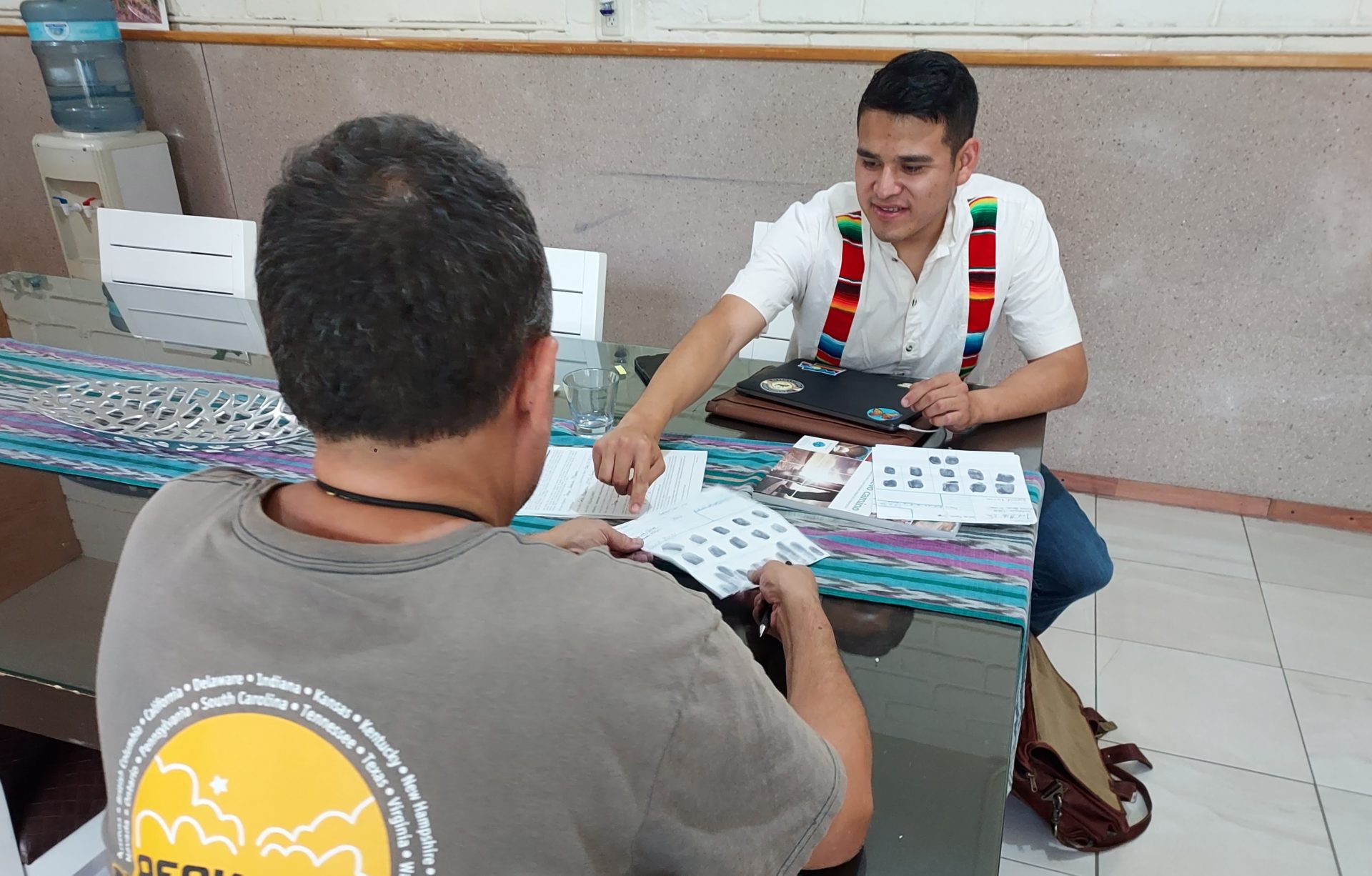
Gerardo joined The Rhizome Center for Migrants’ legal team in Guadalajara in May 2022, from St. Mary’s School of Law in San Antonio, Texas, where he is a rising 3L. After visiting Mexico for the first time in over 20 years, and just six weeks into his legal internship, Gerardo, a DACA recipient since 2015, returned to the United States earlier than expected due to a court case challenging the validity of DACA.
Amid the President’s attempt to fortify DACA without congressional support, we asked Gerardo to share his thoughts on the 10-year program, what it means to be able to travel to Mexico, and his reflections on his experience as a legal intern this summer.
During your internship, you worked on several deported veteran cases. You also met Jorge, whose return to the United States seems unlikely even though that’s where his wife and children live. You met two U.S. citizens brought to Mexico as children who are planning a move back to the United States. And you met retired U.S. expats—migrants themselves—who have seen firsthand how U.S. policies have impacted the region. How did these experiences change how you think about immigration and what you think should be the focus of reform efforts in the future?
While immigration is disproportionately impacted by American politics, it is not all about the American experience. Before this trip, my idea of advocacy narrowed on the need of decency for immigrants who are in the United States; this is important, but I now see that immigration advocacy must be more inclusive. The fight for decency is not lost at deportation, and the immigrant experience does not end with deportation from the United States. There is a community of privileged people—expats—who voluntarily leave the US, and they serve an important role in this conversation. Their binational lifestyle exemplifies that relocation can be positive and less painful when a displaced community is supported. Unfortunately, U.S. citizen children and spouses of deported Mexicans, or deported veterans, do not have those networks of support, or basic resources available to them. Their unmet needs cause pain and will have long-lasting consequences to their prospects in life.
Gerardo, you accepted a legal internship with The Rhizome Center for Migrants in Guadalajara, Mexico, this summer. This was actually your first time to leave the United States in over 20 years. How did you feel when you received news that your request for a travel permit had been approved?
I was in disbelief. The anticipation, however, was confusing because although I was excited to experience Mexico, I was nervous about the risks from leaving the country with Advance Parole. The Mexican culture is a defining part of my upbringing and I embrace it with pride; I was excited to physically reconnect with that side of me. Nonetheless, reentry is not guaranteed with Advance Parole, and the possibility of renouncing to my life in the US, no matter how unlikely, was constantly weighing on me. This anxiety weighed heavily throughout my time in Mexico, including the times that were overwhelmingly positive. One thing is for sure—I never considered backing out. I was determined to make the trip because it was important that I found closure within myself after growing up feeling so close to something that seemed so foreign and inaccessible to me.
Guadalajara is not far from where your remaining family still live and you were able to visit your family several times during your internship. What did it mean to you to be able to spend time with your abuelos, tios, and cousins?
Life changing. Immigrants carry their native places with them. In fact, our values are products of the life of our origins. Hard work, family, relentlessness, and perseverance characterize El Mezquite, Guanajuato, Mexico. It was revealing to me that those were the characteristics that have carried me throughout. Visiting El Mezquite, Guanajuato, helped me to understand myself, especially in my convictions. My parents’ values of humility, perseverance, and unwavering resolve are products of their upbringing there. I admire my roots much more because I saw firsthand the value of honest work. My abuela, tios, and cousins live a humble and wonderful life, and I will forever be grateful for the opportunity to experience the beauty of a binational family. All families deserve the right to experience community, and binational families like my own should be no exception.
Halfway through your internship, the 5th Circuit heard oral arguments in Texas v. United States, a case challenging the DACA program. You were forced to leave Mexico earlier than expected, as a result, and you finished your internship from the United States. Though their lives hang in the balance, the 5th Circuit did not hear directly from any DACA recipient. If you could have testified that day, what would you have told the appeals court panel about what a DACA decision would mean for Dreamers?
Fortunately, the Court does not hold our dreams hostage. Dreamers have prevailed despite the courts and politics—even before DACA. DACA, however, represents our most immediate lifeline. DACA has facilitated our roads to becoming lawyers, doctors, parents, teachers, and contributing members in our communities. I would make the case that, without DACA, our lives will certainly be more difficult, but we cannot and simply will not renounce to our resolve in the United States. Our lives hang in the balance to the extent that the court will dictate how painful our paths will be, but DACA recipients will persevere, nonetheless.
Next May, you will walk across the stage in a doctoral cap and gown. What area of law will you practice, and how do you plan to use your law degree?
Ultimately, I want to work in a civil rights impact litigation organization. In the near future, however, I plan to practice immigration in San Antonio, Texas, because I am passionate about the community there. San Antonio embraced my family; its community has always stepped up along my journey.
I thank The Rhizome Center for Migrants for providing me the space to reinforce my convictions, and for the life-changing experience of traveling to Mexico.
As of the publishing of this post, we are still awaiting a court ruling in Texas v. United States over the validity of DACA, a program that has allowed some 825,000 undocumented Dreamers remain in the United States with the ability to study and work. Their continual contribution to U.S. society and U.S. industries underscore the need for Congress to legislate permanent solutions and provide stability to their lives.
Until Congress passes legislation, DACA and the lives of these Americans remain at risk. The Rhizome Center for Migrants stands in solidarity with Gerardo and all those who deserve to have certainty and stability in their lives.


 English
  Español de México