The Rhizome Center for Migrants
  • ABOUT
  • OUR PEOPLE
  • MEXICO PROJECT
  • EVENTS
  • GET INVOLVED
  • DONATE
  • CONTACT
  • ABOUT
  • OUR PEOPLE
  • MEXICO PROJECT
  • EVENTS
  • GET INVOLVED
  • DONATE
  • CONTACT
April 30, 2019  |  By RCM Admin En News

American Children in Mexico: Young Lives Divided by the Border

Children Crossing
  • Facebook
  • Twitter
  • Email
  • More

[Guadalajara, Jal. April 30, 2019] Among the children we’re thinking of today as we advocate, promote, and celebrate children’s rights in Mexico, are the more than 600,000 American children whose lives cut across the U.S.-Mexico border.

U.S. immigration laws continue to prevent undocumented parents from remaining in the United States with their minor, U.S.-born children. As a result, more than half a million children born and raised in the United States now live in Mexico in order to be with their families. In Mexico, their attempts to complete their education is thwarted by enormous challenges.

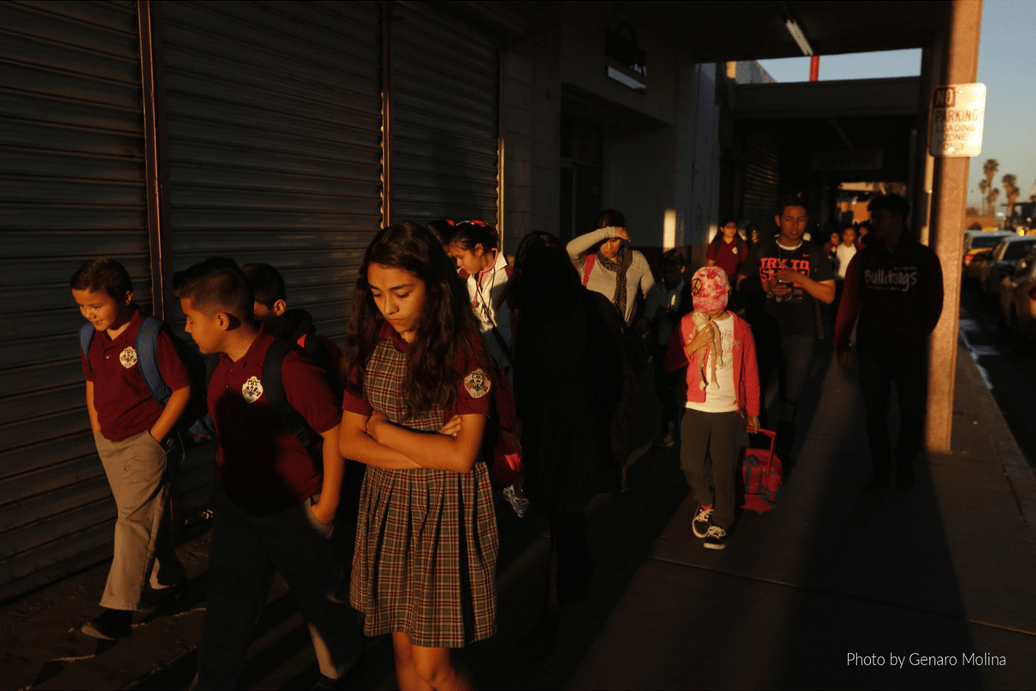
In Tijuana, Mexicali, Palomas, and other border towns in Mexico, thousands of American children cross the border every morning in order to receive an education in the United States. Though they attend U.S. public schools, their family situation and daily challenges hinder their ability to perform well and student scores in those areas are among the lowest in the country.

To receive a public education in Mexico as a Mexican citizen, American children must go through the process of applying for dual citizenship. These children report bureaucratic and economic obstacles in accessing their right to education. As a result, some children never register for school or enter school behind after waiting years for administrative approvals. The majority of students who successfully enroll do not receive the extra support they require initially to succeed and many students end up dropping out.

It is inevitable that children carrying U.S. passports will return to the United States at some point to live and work. Once back in the United States, they may face tremendous hurdles and meager opportunities due to language, cultural, and other barriers created by their forced separation from the United States.

The Rhizome Center for Migrants works with local government officials, academic institutions, and civil society organizations, to locate U.S.-born children currently residing in Western Mexico, and assess effective programming for increasing college opportunities and providing a path out of poverty.

To receive additional updates about our work on the ground in Mexico, subscribe to our newsletter here. You can also help support our local community projects with returned migrants and their children by making a tax-exempt donation to our Mexico Project today.
American children binational families children's day education family unity mexico students U.S.-Mexico border
Previous StoryThe Rhizome Center for Migrants Announces New Technology Strategist
Next StoryPopulation At Risk: Elderly Undocumented Mexican Workers

Related Articles

  • Annie
    How What I Learned Across the Border Will Impact My Future Career as an Immigration Attorney
  • USC Event
    Co-Deported U.S. Citizen Minors in Mexico are Greeted by Staff of the American Services Unit and Received Important Information on Higher Learning Opportunities

News & Press Releases

  • Play Online Pokies That Win Sunday, 24, Dec
  • What Are The Top 10 Online Slots In Belgium Sunday, 24, Dec
  • River Belle Casino Australia Sunday, 24, Dec
  • What Is The Highest Payout Online Casino Pokies In Australia Sunday, 24, Dec
  • Online Blackjack Belgium Legal Antwerp 2024 Sunday, 24, Dec

Updates


The Rhizome Center for Migrants

The Rhizome Center for Migrants

Gathering is resistance.We will be in Mexicali next week in solidarity with system-impacted scholars and activists who are models themselves for a new pipeline: prison-to-deportation-to-higher education. Working across borders, universities, and governments, a small group of activists highlight the incredible effort it takes to turn one's deportation into a stepping stone for lifetime improvement and education. This conference is about pushing for carceral educational opportunities, removing institutional barriers for continuing education, and making room for role models from marginalized communities to stand up and say, "I proved it can be done—you can too."@theundergroundscholars @incarcerationnations @uabc_oficial

… See MoreSee Less


Photo

View on Facebook

·
Share


Share on Facebook


Share on Twitter


Share on Linked In


Share by Email


The Rhizome Center for Migrants

The Rhizome Center for Migrants

Registration is open! This August 7-12, 2026, The Rhizome Center for Migrants will host its 14th Immigration Program in Guadalajara, Mexico. This program is meant for U.S.-based donors, advocates, immigration attorneys, academics, and law students.Our 6-day program humanizes the experiences of those returned, deported, co-deported, and transferred to Mexico, as well as those seeking international protection after the closure of the border. Our program helps advocates to expand their networks, unpack what regional enforcement dynamics mean for those deported in a Trump/Sheinbaum era, spot cross border issues, and learn how to holistically support mixed-status families affected by deportation.Since 2019, The Rhizome Center for Migrants has hosted more than 80 U.S.-based advocates. See which one of your peers has already joined us: tinyurl.com/ys28a33k. Program details: tinyurl.com/d8vbm8bh. Questions and inquiries should be directed to: immersion@rhizomecenter.org.Register by June 15th: lnkd.in/eHvPuBMT

… See MoreSee Less


Photo

View on Facebook

·
Share


Share on Facebook


Share on Twitter


Share on Linked In


Share by Email


The Rhizome Center for Migrants

The Rhizome Center for Migrants

According to Human Rights First, more than 17,400 people have been forcibly transferred to third countries where they have zero ties. Many face violence, arbitrary detention, chain refoulement, have no access to attorneys, and are permanently separated from their families. While Mexico denies being a third country for removal, Mexico has accepted more than 85% of all U.S. third country deportations in 2025-2026.Notwithstanding the arrival of Haitians today due to deportation, the mass migration of Haitians to Mexico occurred during the 2010s and 2020s due to a series of events, including the 2010 earthquake, cholera outbreak, changing economic and social conditions in Brazil and Chile—where many Haitians had fled—economic collapse due to COVID, gang violence, and the inability to seek asylum in the U.S. Today, well over 100,000 Haitians now live in Mexico, with the largest concentrations in Tijuana and Tapachula.As the U.S. ramps up deportations of lawful permanent residents with strong ties to the U.S., Haitians like Jean find themselves in an insufferable situation, held against his will in Southern Mexico without the ability to integrate legally, prove who he is, request a work permit, or leave Mexico. Most deported Haitians don't speak Spanish and lack language skills to navigate the Mexican asylum system, or have a meaningful relationship with their attorneys, if they can find or afford one.📞 UNHCR (Wsp +52 55 7005 5950) or download the El Jaguar app from Google Play or Apple App Store for info about the MX asylum process📲 Rhizome Center (Wsp +52 33 2182 0836) for integration support referrals and info🇭🇹 Haitian Consulate Tapachula (Tel +52 96 2642 8022 or cons.h.tap@gmail.com) for info about how to obtain proof of nationali#Deportationa#USMexicoe#Tabascob#QuintanaRoon#Chiapasiapas

… See MoreSee Less


Photo

View on Facebook

·
Share


Share on Facebook


Share on Twitter


Share on Linked In


Share by Email

About

The Rhizome Center for Migrants is an independent, secular 501(c)(3) nonprofit organization. Our Mexico Project, based in Guadalajara, Jalisco, supports deported and returned migrants through legal aid and reintegration services.


WHO WE ARE

  • ABOUT
  • OUR PEOPLE

WHAT WE DO

  • EVENTS
  • MEXICO PROJECT
  • LEGAL SERVICES
  • SPECIAL REPORTS
  • EDUCATIONAL PROGRAMS
  • GET INVOLVED

ABOUT US

The Rhizome Center for Migrants is an independent, secular 501(c)(3) nonprofit organization. Our Mexico Project, based in Guadalajara, Jalisco, supports deported and returned migrants through legal aid and reintegration services.

FIND US ELSEWHERE

en_USEnglish
es_MXEspañol de México en_USEnglish
Share via
Facebook
X (Twitter)
LinkedIn
Mix
Email
Print
Copy Link
Powered by Social Snap
Copy link
CopyCopied
Powered by Social Snap